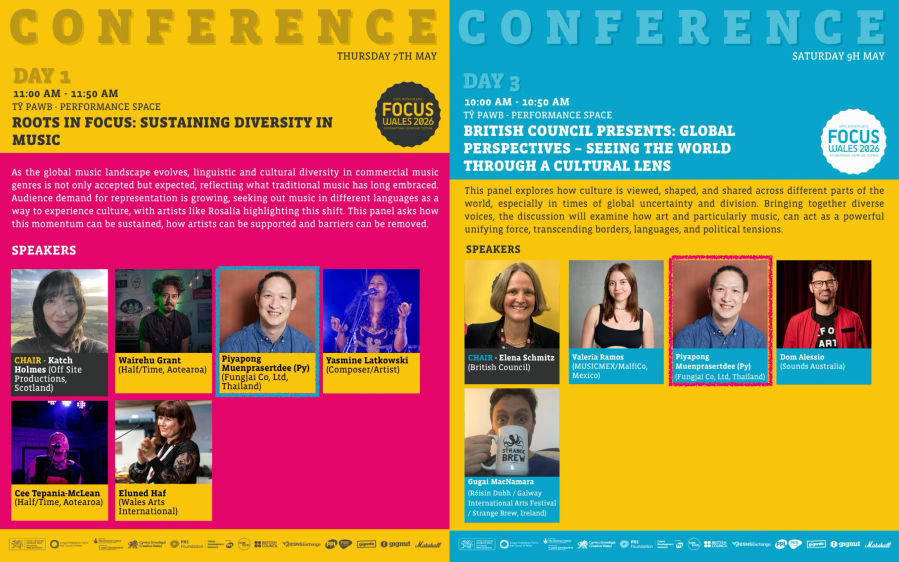
I had the honor of being invited — with support from the British Council Wales — to attend and speak at FOCUS Wales 2026 on two separate panels. The topics were close to my heart: sustainability, diversity, culture and language in commercial music. My first panel consisted a couple speakers from New Zealand — or in the native language, Aotearoa. They spoke about how colonialism has affected the local Māori people, and how it still shapes their social, political and cultural ecosystems today. I found myself drawn into the conversation perhaps a little too passionately. That conversation is what led me to writing this to reflect on my thoughts…
Non-Western artist? Non-Western music.
About ten years ago — around 2016, when I first started going out to international music conferences and showcase festivals — I would enthusiastically introduce people to Thailand’s music scene and play Thai indie tracks off my iPhone for anyone willing to listen. People would give me some comments, but the same question came back at me again and again, especially from Western delegates: “Do you have any bands that have traditional Thai instruments in their music?” When I asked why having a traditional instrument was important to them, which their answers were in the line of: “If I booked an Asian band that sounds like one that people could already see in Europe, why would anyone want to see them?”
Being repeatedly asked about “traditional” instruments felt slightly insulting — as though we were being pushed into an exoticised, Orientalist narrative that someone else had already written for us. It reminded me of my first trip to the UK in 1995 on a cultural exchange program, when a few English kids asked whether we rode elephants to school.
The answer was obvious to us Thai exchange students — of course not! We took the school bus, watched TV and played video games — just like kids in England. And in our teens, we grew up listening to modern, Westernised commercial music with guitars, bass, drums, synths and so on. Those were the sounds that inspired us, and naturally those became the music we made, recorded and performed. So what’s the problem with a Thai band making rock, pop, metal or funk? If we didn’t grow up with traditional Thai music, how were we supposed to play a Thai traditional instrument anyway? And even if we did, wouldn’t we just get pigeon-holed into “World Music”?
Regional music goes global
Fast-forward to 2026 and the global cultural landscape has shifted dramatically. The worldwide success of K-pop, alongside the rise of 88rising — the New York-based label founded in 2015 by Sean Miyashiro and Jaeson Ma — promoting Asian artists in the U.S. and beyond, has fundamentally challenged the old assumptions about what “global” music is supposed to sound like. In addition, platforms like TikTok have accelerated the flow of Asian culture into international markets in ways traditional gatekeepers never could.
More interestingly, in Southeast Asia at least, TikTok has revived and popularised regional and previously marginalised music genres that were once dismissed as music for rural, “low-class” country folk — genres such as Luk Thung in Thailand, Dangdut in Indonesia, and Budots in the Philippines through memes, dance trends and user-generated short-form videos. These sounds have spread virally in the Gen-Z population whether urban or rural, across borders and generations, unexpectedly reshaping the musical palette of audiences both at home and abroad.
I previously wrote a blog post for my AXEAN Festival website about music in Southeast Asia that mixes local country music with EDM, which is a really interesting phenomenon viralized by TikTok. I included the example of a 2001 K-pop track “My Lecon” by jtL remixed in the Indonesian “Full Bass” or “Jedag‑jedug” style by DJ Prengky Gantay that became a viral hit in 2022 thanks to the cheerleading squad of the Kia Tigers, a KBO League baseball team based in Gwangju, South Korea.
My theory is that social media — together with the content ecosystems it created and the younger generation raised within them — has played a major role in normalising and celebrating traditional, folk and working-class music cultures. As a result, the incorporation of traditional instruments, regional sounds and local musical identities into contemporary music no longer feels outdated or provincial. Increasingly it feels authentic, distinctive and culturally valuable. At the same time, more people from immigrant and diasporic backgrounds are openly embracing and expressing pride in their heritage, while international artists are becoming far more confident about presenting their national and cultural identities on global platforms.
Contemporary music = Colonial music
So then I want to ask this question: “Why did so many countries move away from their traditional music in the first place and gravitate toward Western commercial music?”, which I think I found some answers in my previous researches on Southeast Asia
Nearly every country in Southeast Asia experienced direct Western colonial rule in one form or another. The British Empire controlled Myanmar, Malaysia and Singapore (with Brunei as a protectorate); the French colonised Vietnam, Laos and Cambodia under what became known as French Indochina; the Philippines passed through Spanish and later American colonial control; the Dutch established the Dutch East Indies in what is now Indonesia; and the Portuguese maintained colonial rule in Timor-Leste for centuries (Wikipedia). If you have ever visited these countries, you can still see the remnants of their colonial era in their contemporary cuisines, cultures and music.
Thailand, then called Siam, was never formally colonised — but it was no less affected by colonialism. To avoid being colonised, it underwent rapid modernisation and made significant concessions under pressure from Western powers in order to survive as a buffer state between British and French colonial territories. The Bowring Treaty of 1855 with Britain — the first of fifteen “unequal treaties” Siam would sign with Western powers — forced open the economy, capped tariffs at 3% and granted extraterritorial rights to British subjects, etc.
The modernisation strategy initiated by King Rama V (Chulalongkorn) and continued through the post–World War II era is the usual story of how Thailand maintained sovereignty against expanding Western powers. But the suppression of traditional culture in the name of looking “civilised” came later and was more aggressive than people remember. Under Field Marshal Plaek Phibunsongkhram’s Cultural Mandates of 1939–1942, the state issued twelve edicts, e.g. renaming the country from Siam to Thailand; mandating Western dress and banning the wearing of traditional wraparound cloth in public; broadcasting Western classical music whilst suppressing traditional Thai music; and standardising language and conduct.
We were trying to prove ourselves “modern,” which in practice meant trying to be more Western.
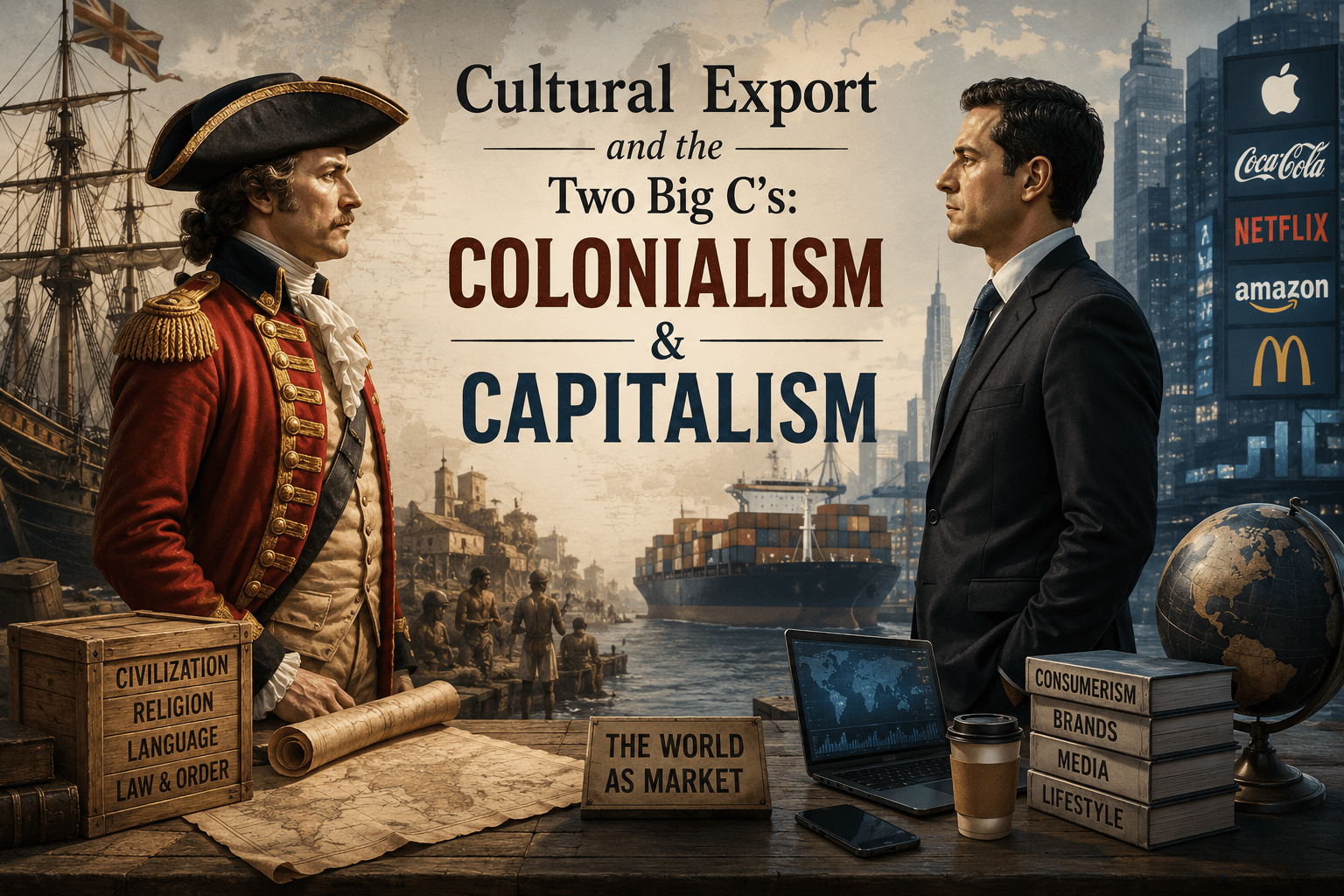
Colonialism / Capitalism – same same la
Then came the Vietnam War. The arrival of American military forces and air bases transformed parts of Thailand socially, economically and culturally. They brought their music, fashion and entertainment culture. Bangkok was an official R&R (Rest and Recuperation) destination for U.S. soldiers on leave from Vietnam, and Pattaya — then a small fishing village near the U-Tapao naval air base — developed almost entirely around that demand. At its peak, more than 50,000 U.S. servicemen were stationed in Thailand. Bars, clubs and live music venues bloomed around them.
My mother came from this era. Born in 1950, she grew up listening to artists like The Carpenters and The Beatles on the radio. That music inspired her to learn English, join the AFS Intercultural Programs student exchange to the United States in the late 1960s, and eventually pursue a career as an English language educator. She once told me about a G.I. bar near her hometown in northeastern Thailand where she had subbed for the regular singer one night, performing Western cover songs for American soldiers. From my own research, I found that the culture of performing Western popular covers in G.I. bars was, in many ways, the foundation of Thailand’s modern music culture, and eventually the industry itself.
So, Thailand was not “formally” colonised, but “economically” — and to an extent “politically” — colonised, in my honest opinion.
But let’s put my loose comparisons aside. From what I have read, colonialism and capitalism developed hand in hand and reinforced each other. The colonial project was driven by very capitalist needs: exploring for new markets to sell your stuff; discovering new products to sell back home; and finding cheap sources of material and labour to produce your products. Parallels include forcing China and Japan open for trade; importing tea, silk and spices; and enslaving local populations for production, while also buying and selling them like cattle.
And if you think colonialism is over now, the concept of “digital feudalism” — popularised by economist Mariana Mazzucato and developed further by Yanis Varoufakis in Technofeudalism — makes me think we’re still in some dystopian version of it. Platforms own the digital land. Creators, drivers, sellers and small businesses pay rent to the lords. Not everyone agrees with the framing (some argue it’s still capitalism, just monopolised), but the basic shape of it — a handful of platforms extracting from billions of users — is hard to argue with.
Ex-colonisers are still rich, ex-colonies are still poor (mostly)
World War II both divided and, oddly enough, united the world a great deal. The United Nations was created in 1945 to keep peace; the General Agreement on Tariffs and Trade (GATT, signed 1947, replaced by the World Trade Organization in 1995) was created to spread prosperity through trade. But the Western imperial powers had already become so wealthy from their colonies that wealth could not realistically be redistributed evenly afterwards. We can’t change the past, and the ex-colonisers aren’t handing back their gains, but should they at least find a way to offer reparations to their ex-colonies somehow?
After one of the panels, I was still debating with a fellow speaker who asked the hypothetical question, which I paraphrase: “We can’t fix the past. So, what if we imagine there had been no colonisation, can we move forward with that to improve the situation?”
I thought for a quick minute and answered that I can’t imagine a version of human history in which humans don’t try to take over the land and resources of other humans. The only way I can imagine a world without colonisation is to imagine a different human species altogether — something like a bonobo versus a chimpanzee.
Bonobos are interesting because for decades science assumed they were just a smaller variant of the common chimpanzee; they weren’t classified as a separate species, Pan paniscus, until 1933. Chimpanzees, our other closest living relative, are violent and territorial, and run turf wars that look uncomfortably familiar. Bonobos resolve almost every conflict — including ones we would settle with violence — through sex and social grooming, and have famously never been observed killing one of their own.
The catch is that a species like that probably doesn’t invent very much. A lot of the technology we live with — the internet, GPS, jet engines, radar, nuclear power, modern computing, even canned food — came out of war or out of preparing for one. If humans had taken the bonobo path, we would almost certainly be a kinder species — and have no colonization. We would also almost certainly be a poorer, less technologically advanced one. I don’t have a clean answer about which trade I’d take. What I’d say is that the case for reparations doesn’t actually require us to imagine a non-violent humanity that never existed. It just requires us to be honest about who paid for the technological one we got.
Thus, I think colonization and its affects is a topic that needs to be discussed although it may be uncomfortable to many people.
Culture & soft power
Let’s come back to the Americans. During the Vietnam War, their troops exported their music and entertainment culture into Thailand. The same effect played out in Japan after WWII and in South Korea during and after the Korean War. This is the basis of Joseph Nye’s theory of “soft power”, which he coined in 1990 and elaborated in his 2004 book Soft Power: The Means to Success in World Politics. (Nye died in May 2025; his framework is now half a working theory, half a memorial.) The argument is simple: people buy stuff because they’ve seen it in movies, worn by their favourite artists, or stamped “Made in USA.”
That insight is exactly what the South Korean government decided to act on, especially after the 1997 Asian Financial Crisis. Euny Hong’s book The Birth of Korean Cool documents how Seoul decided to treat cultural content as an export industry. The Ministry of Culture’s budget grew sharply through the 2000s. The Korea Creative Content Agency (KOCCA) was set up in 2009. Funding went into everything from K-drama distribution to game studios to the touring infrastructure that eventually carried BTS. Squid Game and Parasite are proof of its success on that bet two decades later.
Another topic I raised on the panel was why Disney has produced so many animated films set in non-Western cultures over the past decade, e.g. Mulan, Moana, Coco, Encanto, Raya, Turning Red. The friendly read is that it fits the corporate DEI framework: representation for the Americanised diaspora kids who were always there but never saw themselves on screen. The cynical read is that Disney spotted an untapped market — those same diaspora households at home, plus a much bigger international box office that responds better to local-feeling stories (Coco in Mexico, Encanto across Latin America) — and acted accordingly. Both can be true at once, but I lean toward the second.
This isn’t really soft power in Nye’s sense, since no government is steering it. It’s just capitalism working its magic.
Cultural exchange programs and who pays for them
Reading about South Korea, it’s easy to forget that European governments figured this out a century ago. The British Council was founded in 1934 — partly to counter rising fascist propaganda in Europe and Latin America — with the explicit mission of promoting British culture, language and education abroad. It is sponsored by the Foreign, Commonwealth and Development Office, and the UK government calls it, in writing, a “soft power” instrument. In January 2025, the Foreign Secretary and Culture Secretary jointly launched a new UK Soft Power Council to make that strategy more deliberate. The Institut français traces its lineage to 1907 and now sits under the French Ministry for Europe and Foreign Affairs; its job is, plainly, the promotion of French culture overseas. The Goethe-Institut, founded in 1951 (with a more uncomfortable Deutsche Akademie predecessor from 1925), does the same for Germany.
There is also a quieter, music-specific layer underneath all of this. The European Music Exporters Exchange (EMEE), based in Brussels and funded by the EU’s Creative Europe program, networks 37 national and regional music export offices across 30 countries — France’s Le Bureau Export now officially absorbed into the Centre National de la Musique (CNM), German Music Export, Music Norway, Music Finland, Music Estonia, Sounds From Spain, Music From Ireland, PRS Foundation (UK), etc. Their stated mission is to support the cross-border circulation of European music. A 2025 academic study in the International Journal of Cultural Policy describes them, accurately, as “hybrid policy instruments” navigating cultural, trade and soft power agendas at the same time. Translation: they are not neutral. They exist to move European artists outward.
The other interesting piece is what these agencies do inward. When British Council funds a delegate from Southeast Asia to attend a UK music conference and festival — which is, transparently, what happened in my case — that is also soft power, just running in the other direction. A visiting delegate is not being flown in just because the UK is curious about Southeast Asian music in the abstract, they are being flown in to: build a positive impression of the UK abroad; create networks that later carry UK bands to Asian festivals; demonstrate the UK’s hospitality, openness and cultural relevance; and meet other delegates from elsewhere on British soil. Inbound mobility is a strategy, and is what cultural diplomacy looks like when it is done well.
The asymmetry shows up if you look at the flow over time. Money, festival slots and PR machinery move outward from London, Paris and Berlin in vastly greater volumes than they move outward from Bangkok, Manila or Hanoi. We do not have a Thai Council with close to a £ billion annual budget and offices in a hundred countries. We do not have a Vietnamese equivalent of the Goethe-Institut placing language teachers and curators in Lagos and Lima. The few coordinated efforts that exist in our region — Thailand’s “5F” strategy, Indonesia’s creative economy push, the Korean playbook everyone else is trying to copy — are still smaller and younger. The soft power infrastructure we are being invited into was built by other people for other reasons, and it predates us by several generations.
So when one of our artists gets funded to fly to Europe, two things are simultaneously true. It is real opportunity and real progress for our artist; it is also part of an old machine, running on a budget our governments did not set, towards goals our foreign ministries did not write. Both halves are worth seeing at the same time.
Soft power for the rest of us
Thailand has tried to copy South Korea’s playbook with the “5F” strategy — Food, Film, Fashion, Fight (Muay Thai) and Festival (read my satirical piece on it if interested) — announced in 2023 and pushed harder since. Indonesia has invested in dangdut and koplo exports and the wider creative economy. The Philippines just had a record year for music exports through SB19 and BINI. Vietnam’s V-pop is finally cracking Spotify’s global charts. Whether any of these efforts can match South Korea’s scale is an open question, partly because they also spent two decades building the labels, agencies and training systems underneath the strategy. You can’t soft-power your way past missing infrastructure.
There is a harder question I keep landing on. The platforms that have made all this possible, e.g. YouTube, Spotify, TikTok — are owned by American and Chinese capital. The “decolonisation” of global taste is happening through the same extractive plumbing that used to push only Western pop outwards, e.g. Luk thung trending on TikTok is genuinely good for Thai musicians whilst also good for ByteDance; a diaspora rapper signing to a major label and singing in their mother tongue is real progress, but the master rights still sit in New York or London, etc.
So… What’s the learning here?
Looking back at the conversations in Wrexham that prompted all this, I think what bothered me about the elephant-riding questions in 1995, which emotionally related to the Thai traditional-instrument questions in 2015, was never really about the instruments. It was about who got to decide what an authentic Thai band sounded like. My opinion is that when someone else demands you play your traditional instrument to be accepted on a Western stage, that’s exoticism. But when a Thai artist chooses to weave Luk Thung phrasing into a pop song because they grew up with it, that’s authorship. The sound can be identical; the power relationship is opposite. That distinction is the entire game.
So maybe the honest version of the argument is this: the demand for non-Western music has democratised; the supply chain has not. Whether the next generation of Southeast Asian artists ends up owning more of that chain — labels, publishing, platforms, festivals, distribution — is the actual test of whether anything has changed. The instruments we play, traditional or otherwise, are the smallest part of it.
Same same la, but different. Maybe.
By Py Piyapong Muenprasertdee
Remark: Edited for clarity and style using AI. The concepts and arguments are original.
 Py the Thai Guy