
In October 2025, I was invited to speak at the RIUH x ASEAN frequenSEA music conference in Kuala Lumpur, Malaysia on how Southeast Asia’s live music industries can collaborate and thrive without relying on Western capital or intervention. My schedule was already overflowing, but this is a topic related to sustainability and music, which I care deeply about—so I said yes!
If you’d like to see the presentation slides I did, you can see it on my SlideShare. But if you want to read through this article, here goes.
What Does a Healthy Music Ecosystem Look Like?
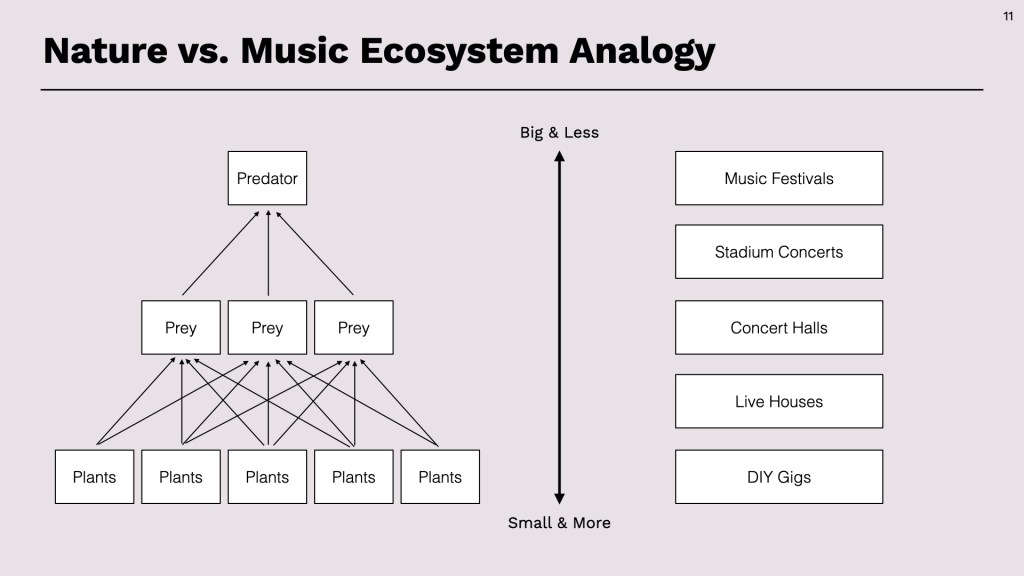
If our goal is to have a healthy music ecosystem, let’s imagine a natural ecosystem. Should it be a uniform forest dominated by a handful of species, or a wildly biodiverse rainforest—layered, complex, full of plants, insects, reptiles, birds, and mammals all playing different roles? I’d say the latter, wouldn’t you agree?

And in that biodiverse rainforest, the balance matters.
You have an abundance of plant life at the base, a large population of smaller creatures above that, and only a limited number of apex predators at the top. It’s a food-chain pyramid. If the top gets too heavy, the whole system collapses.
The music ecosystem works the same way.
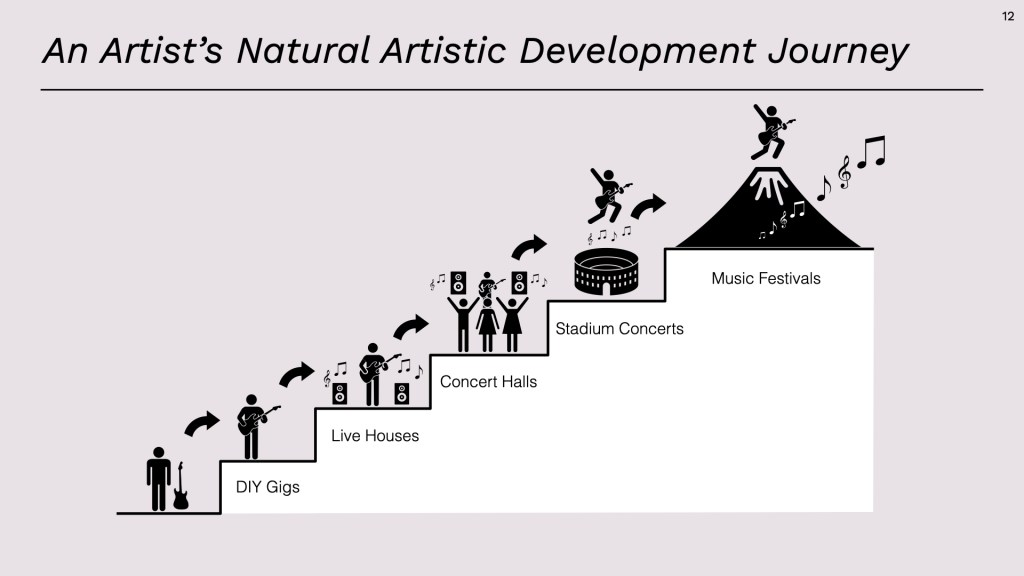
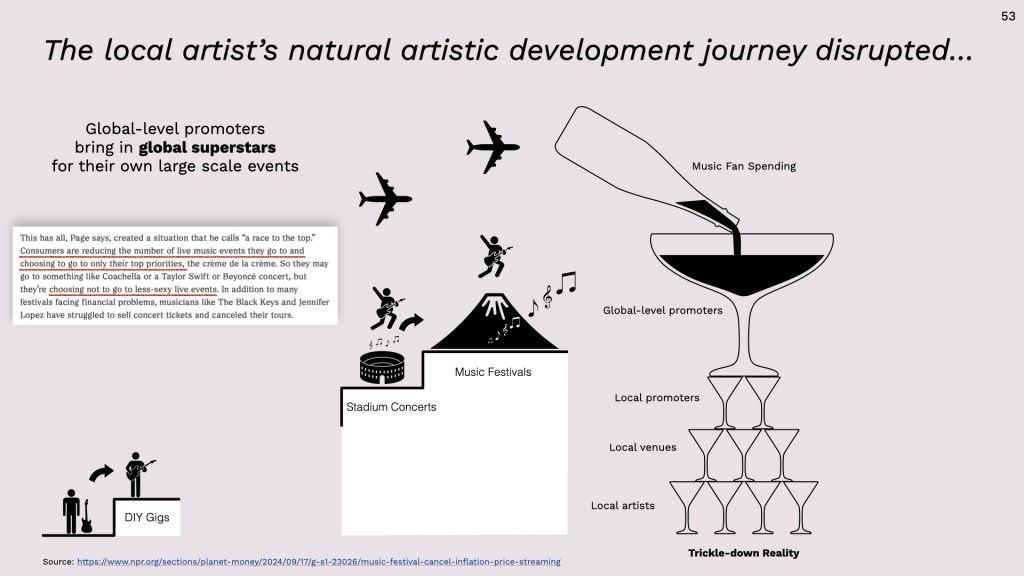
We need a wide base of small gigs—club shows, community stages, experimental nights—where artists grow and audiences discover. Above that, a healthy layer of mid-sized events that scale momentum and sustain careers. And at the very top, a handful of mega concerts and major festivals.
Although not every artist makes it to the top, they follow a general development journey—starting by playing small shows, honing their craft, and playing bigger shows to larger audiences.
The “Trickle-down” Effect
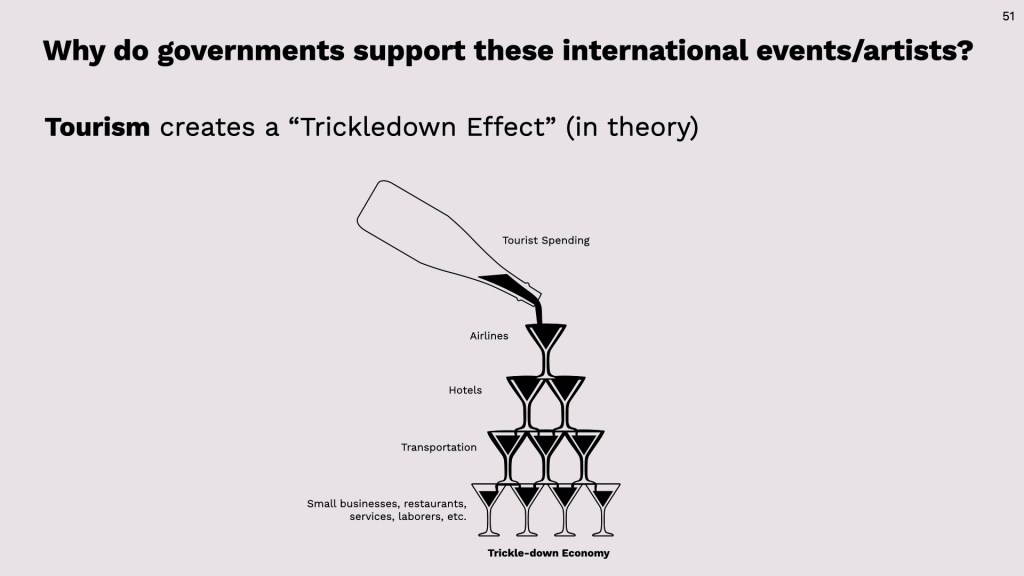
The trickle-down effect, particularly in tourism, is the theory that economic benefits generated by tourism investments and tourist spending—such as on hotels, airlines, ground transportation, and related services—naturally disperse to the broader, lower-income local community, creating jobs and reducing poverty.
Some governments have devised and executed music-tourism strategies attracting international tourists, for example, the Singaporean government reportedly brokered a US$2 million to US$3 million deal for Taylor Swift to perform six shows in exchange for keeping the concerts exclusive to Singapore in South-East Asia (The Star, 10 MAR 2025), and the Thai government approving a five-year agreement to host the world-renowned Tomorrowland music festival (The Nation, 29 JUL 2025), offered full government support to Electric Daisy Carnival (EDC) Thailand as part of a long-term growth strategy (PR Thai Government, 19 DEC 2025), not to mention its support for bringing Japanese music festival brand Summer Sonic to Bangkok (Money & Banking Online, 27 MAR 2024).
Maybe it works for tourism, but does it work for the music industry?
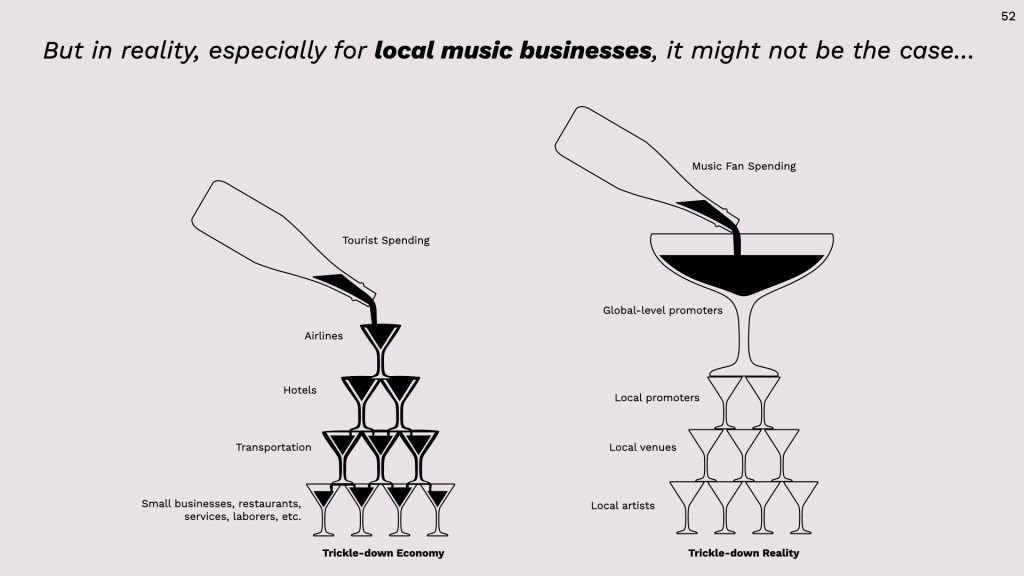
According to an article on NPR.org (17 SEP 2024), the live music industry experienced a strong rebound after the COVID-19 pandemic as audiences rushed back to concerts and festivals. However, the resurgence was short-lived as numerous festivals began canceling due to rising production costs, softening demand, and a noticeable shift in consumer spending. Many fans are now saving their money for premium events—the crème de la crème—such as Coachella or stadium tours by artists like Taylor Swift and Beyoncé. The result is a top-heavy economy that functions like a dam rather than a waterfall: money pools at the top among superstars, leaving the local grassroots ecosystem downstream to run dry.

Are we being “Force-fed” Global Superstars?
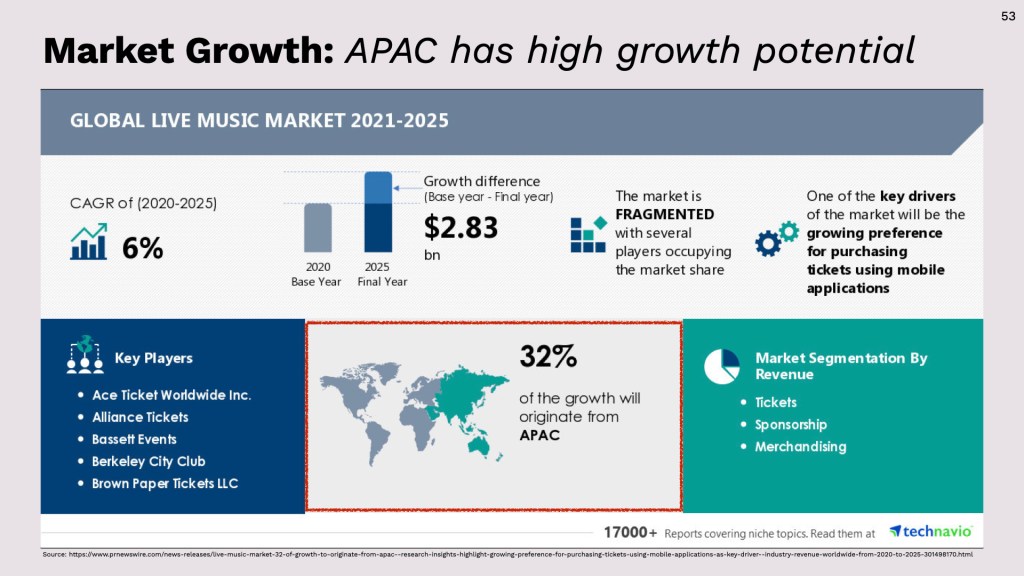
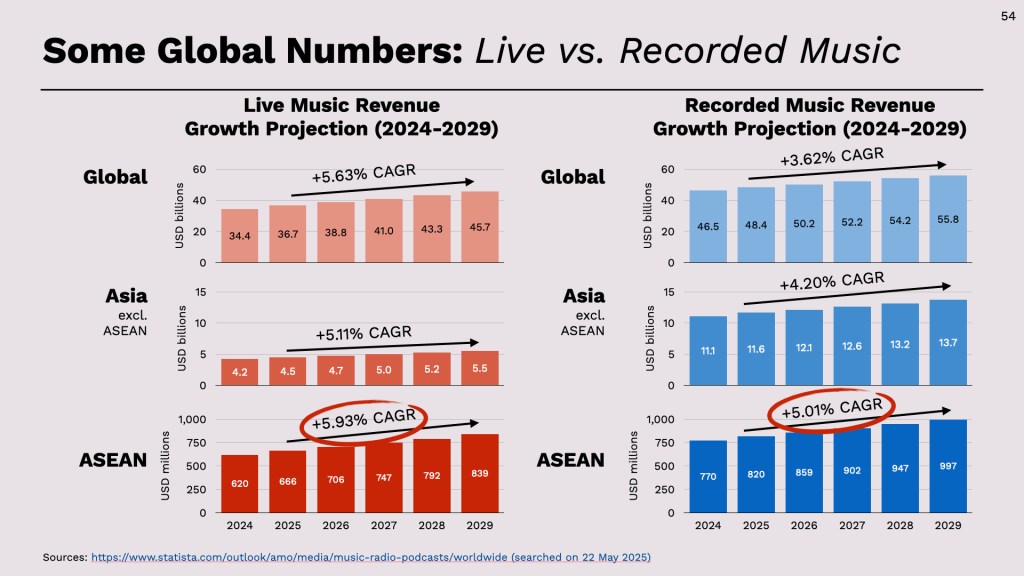
This question struck me after witnessing the recent influx of global icons performing across Southeast Asia—artists typically backed by massive international conglomerates. A decade ago, the narrative was different: major record labels were aggressively establishing regional subsidiaries to nurture local talent and creating regional superstars. But in recent years, I’m seeing those same offices are shuttering, despite an increase of importing global IP. This trend seems to align with studies highlighting the Asia-Pacific region as a key economic growth engine. Rather than investing in the infrastructure of a developing industry, major conglomerates are leveraging their most powerful global assets to dominate a market with immense, untapped consumer potential.
Another factor is the emergence of ‘Trigger Cities’—densely populated hubs in developing regions like Latin America and Southeast Asia. In these markets, new tracks can go viral rapidly, ‘triggering’ streaming algorithms that spark a global snowball effect. Because digital marketing and advertising costs are significantly lower in these territories, it seems like a plausible cost-efficient strategy for major labels to test and amplify their global hits before they ever reach Western markets (Sure Shot: Music Marketing in Trigger Cities, Musically, 10 JUL 2019).
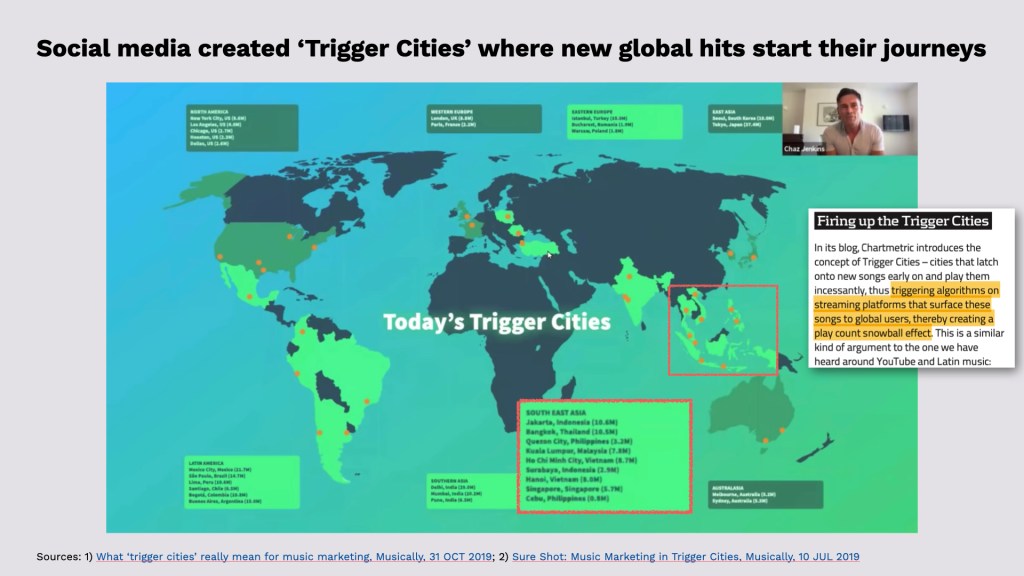
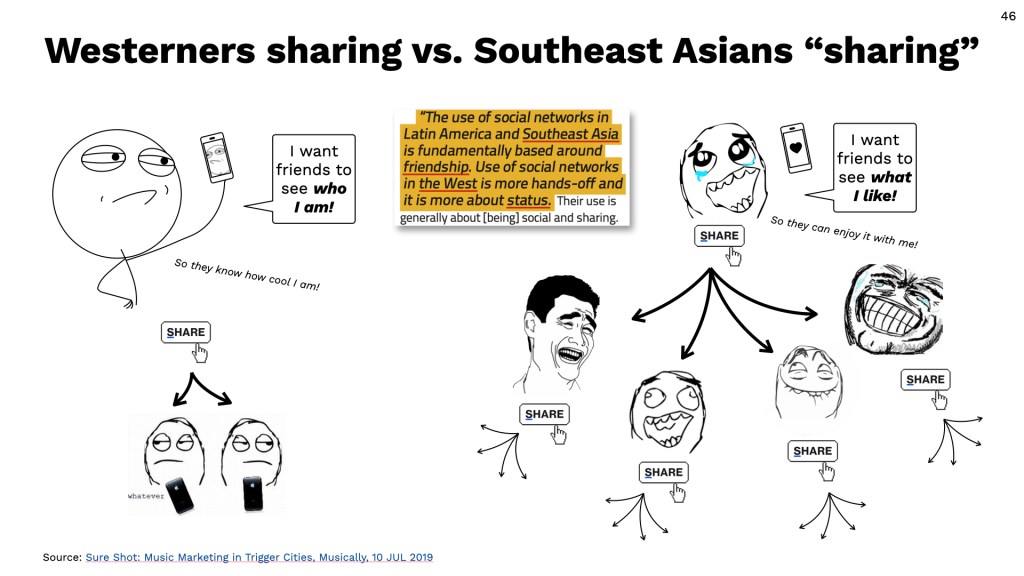
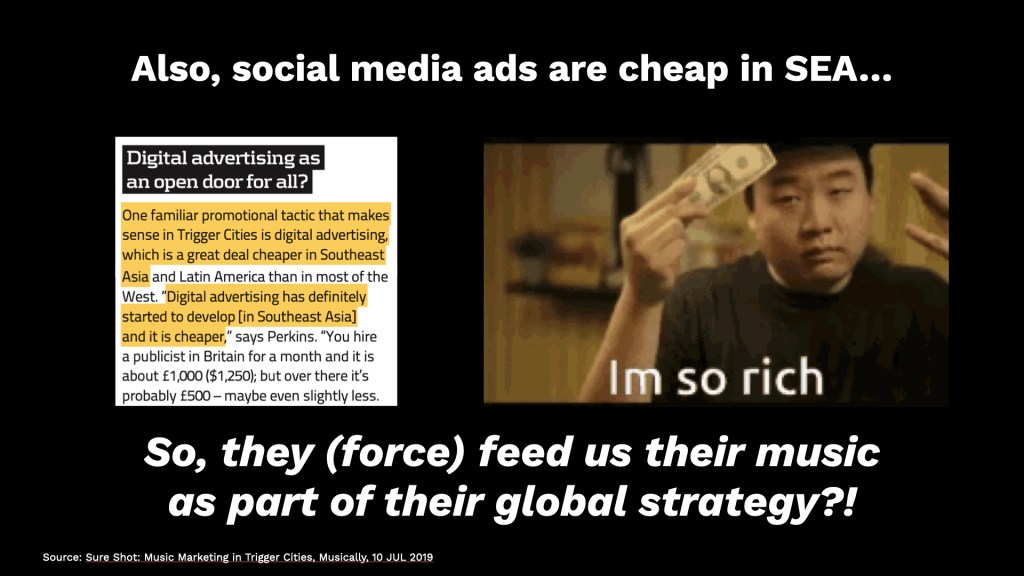
While global labels can leverage our ‘Trigger Cities’ to manipulate the streaming platforms and social media algorithms, they rarely reinvest those profits into our local infrastructure. We should view this as a wake-up call. If our markets have the power to ‘trigger’ a global hit, we can use that same mechanism to our advantage. By developing regional talent and mastering the viral snowball effect ourselves, we can force the algorithms to notice our artists, effectively exporting our own culture back into their markets.
Proposed Policy Framework
The music industry runs on a global capitalist system, so trying to block international companies from entering new markets is virtually impossible and likely to backfire. However, we can still use smart policies to make sure that this global influx doesn’t crush our local scenes. I believe that by setting up some basic protections and growth plans, we can build an industry that is more sustainable. I’ve put together these proposals with Southeast Asia in mind, but I believe they could work for other regions facing the same challenges.
1. Open to International Music Businesses whilst also Protecting Local Businesses
- Mandated Local Labor & Knowledge Transfer
- The Problem: International promoters sometimes “parachute” into a market, importing their own equipment and manpower, which creates a “leakage” of revenue where capital exits the country, and local workers are denied the opportunity to gain high-level experience.
- The Policy: Enforce a minimum quota for hiring local technical crews, event managers, and service providers for large-scale international productions. Furthermore, international firms should be required to facilitate knowledge transfer, such as providing workshops or mentorship programs to ensure new generations of local professionals are equipped to sustain the future industry.
- Protecting Grassroots Infrastructure (Venue Viability)
- The Problem: Local venues are the vital “stepping stones” of the artist’s journey. Without small-to-medium stages, emerging talent has no place to hone their craft, creating a gap between “bedroom artists” and “stadium stars.”
- The Policy: Implement tax incentives or grants for independent music venues to offset rising operational costs. These spaces should be treated as cultural landmarks rather than just commercial real estate to ensure that the local talent pipeline remains active and local artists have the platforms necessary to develop their careers.
- Scaling Homegrown Events into Global IPs
- The Problem: While we import global festival brands, we may under-invest in our own local festivals. They may have the potential to become global exports, but lack the initial capital to scale.
- The Policy: Establish a dedicated National Music Export Fund to provide low-interest loans or grants to domestic event organizers. By supporting them, we can move from being a consumer of international intellectual property to an exporter of our own cultural IP.
2. Support Music Export & Artist Exchange Initiatives
- Regional Mobility: Streamlining Artist Visas & Work Permits
- The Problem: In Southeast Asia, performing in a neighboring country is very difficult due to artist visas and work permits being expensive, takes forever to get, and sometimes not go through official procedures at all.
- The Policy: Establish visa-free and work permit-free programs for regional artists. By lowering the cost and complexity of touring, we can cultivate “Regional Superstars” whose popularity can eventually balance the overwhelming demand for Western global icons.
- Strategic Soft Power: Music Export Offices & Mobility Funds
- The Problem: The high cost of international transport and accommodation—often outweighs the potential revenue from ticket sales and sponsorships for rising artists, which prevents local talent from reaching global stages.
- The Policy: Formally establish National Music Export Offices to subsidize the international travel of domestic talent at all career levels—from independent acts playing small clubs to headliners at major international festivals. This isn’t just about the artists; it gives local technical crews and professionals a vital chance to learn from their international counterparts across all venue scales. Furthermore, governments should view these funds as a strategic investment in Soft Power. Exporting music acts as a “cultural vanguard” that drives tourism and creates a halo effect for other national exports, including food, manufacturing, and media like film and television.
- Expanding the Marketplace: Support for Music Business Ecosystems
- The Problem: High-level music business networking remains heavily concentrated in Western markets (e.g., SXSW or Midem). Without regional hubs for deal-making, the Southeast Asian music industry remains insular and domestic, limiting its growth potential.
- The Policy: Provide government grants and tax breaks to local organizers of International Music Business Conferences and Trade Missions. By hosting these events locally, we can facilitate cross-border business relations and create a “springboard” for domestic labels, promoters and music startups to enter the global marketplace.
Investing in The Arts is a Direct Investment in People
I want to close with this: investing in the arts—including contemporary music—is a direct investment in a country’s people and its economic future. I urge governments to take this seriously. If my argument isn’t enough yet, I hope the research and references listed below can serve as a starting point, or better yet, encourage conducting their own studies into how much the creative industries truly contribute to society.
In my own experience organizing events, the Thailand Convention & Exhibition Bureau (TCEB) has been an invaluable partner. Beyond providing funding, they commissioned research to study the socioeconomic impact of our festivals. For some of these events, the data showed that the estimated tax revenue generated from event-related activity was nearly enough to cover the entire cost of the festival itself.
Despite this evidence, it is still a struggle to get other government agencies on board. Often, they feel music doesn’t fit their specific “mission,” or they believe they should only support traditional culture.
This is a major missed opportunity. I truly believe that creativity is the source of innovation. Innovation increases productivity, and productivity leads to prosperity. Furthermore, a vibrant music scene acts as a magnet for talent. Young, capable professionals want to live in places that feel alive. When a city has a “soul,” it attracts the very people who will build its future economy with the proof already out there:
- Creativity as Fuel: “Creativity [is] the fuel of innovation.”, M J Gilmartin, School of Nursing, University of Virginia, Charlottesville, USA.
- The Talent Magnet: “A thriving music scene attracts talented young people to cities.” (Richard Florida, ‘The Rise of the Creative Class’)
- What Workers Want: “Millennials are attracted to companies that allow and encourage creativity” (2011 PwC Millennials at Work)
- The Industrial Connection: “[Gothenburg’s] huge industrial companies want culture and music to flourish because they see the link to attracting young workers to their companies.” (Fredrik Sandsten, Gothenburg Tourism Agency via The Mastering of a Music City – Presented by IFPI, Music Canada in association with Midem)
- New Productivity: “Creativity is the new productivity in the modern era of work and workplaces.” (WorkPlaceInsight.net)
 Py the Thai Guy